
Termite Control in Northeast Philadelphia
Subterranean termites, carpenter ants, carpenter bees and powderpost beetles all damage wood, mostly where nobody looks. The signs each one leaves decide how the problem is handled.
Subterranean Termites Live in the Soil, Not the Wood
The termite that damages houses in southeastern Pennsylvania is the eastern subterranean termite. Its colony lives underground, and the workers travel up to feed, staying inside the wood or inside tunnels of soil, because open air dries them out.

Those tunnels are the mud tubes people find, about as wide as a pencil, running up a foundation wall, a cellar pier or a step. Brick and stone do not stop them: the colony comes up through cracks in a slab, gaps in old mortar and the openings around pipes. Where termites reach finished wood, they pack mud into the joints to keep the air out, which is how a seam of dried soil ends up between a door casing and the wall.
Termite Damage Stays Hidden Inside Sound-Looking Wood

Termites eat the softer layers of the wood and leave the harder grain and the surface, so a joist or a sill can look whole while its inside is mostly tunnels, with soil stuck to their walls. Painted trim may bubble, and a screwdriver can sink into a baseboard with little effort.
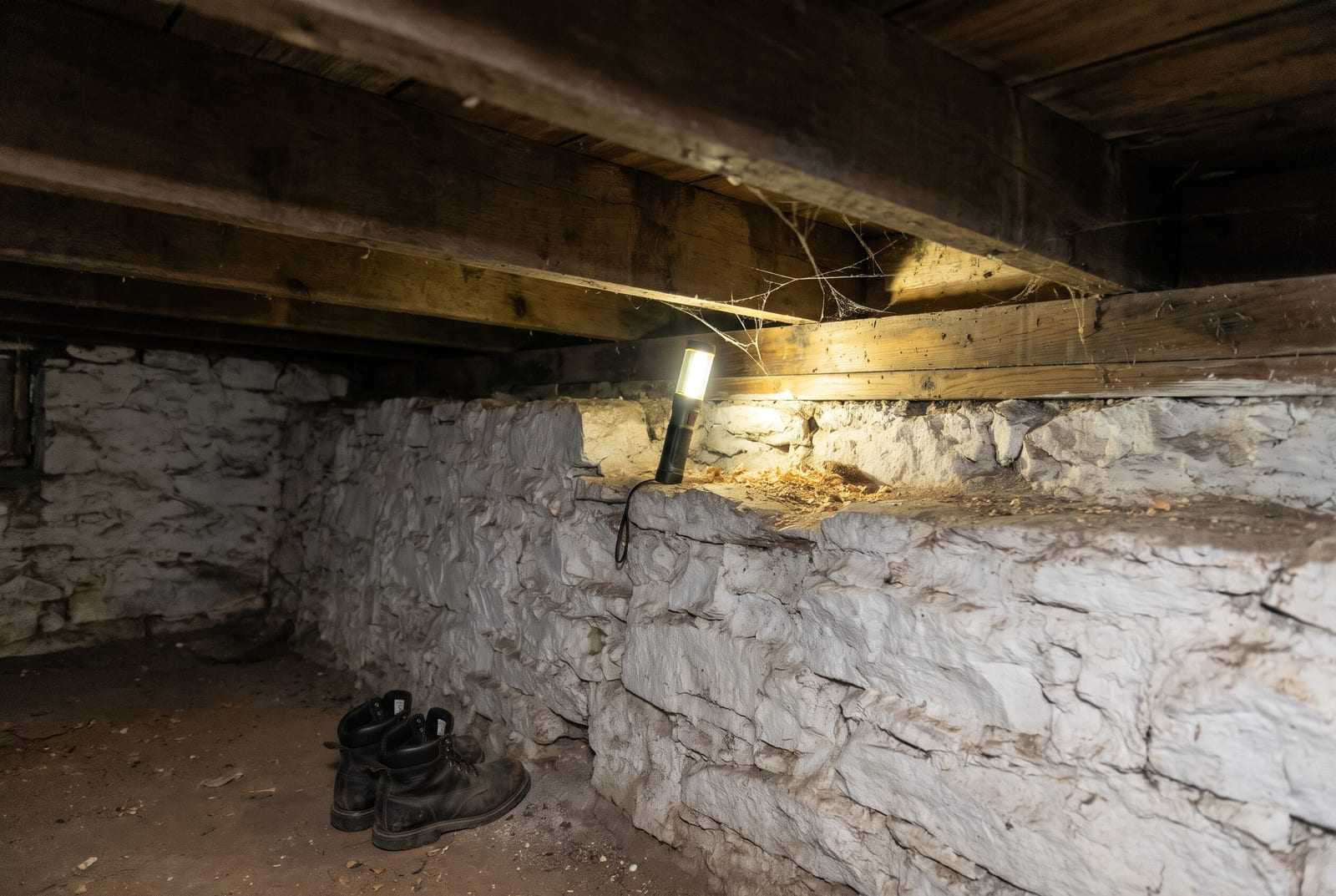
In older Philadelphia houses, the wood closest to the ground goes first: the sill plate on a stone or brick foundation, the joist ends, cellar stairs, porch framing and door frames.
Ants, Bees and Beetles Are Often Mistaken for Termites
Carpenter ants hollow out damp wood for their nests without eating it. Carpenter bees bore round holes into bare outdoor wood. Powderpost beetles spend months or years inside wood as larvae and leave through tiny holes. In the trade, carpenter ants are traced back to their nest and the wet wood around it, carpenter bee holes are dusted and then plugged, and wood with active beetles is treated with a borate or replaced.
| Insect | Typical signs | Parts of a building affected |
|---|---|---|
| Eastern subterranean termite | Pencil-width mud tubes; swarmers or shed wings in spring; layered wood with soil in it | Sill plates, joist ends, door and window frames, baseboards, cellar stairs, porches |
| Carpenter ant | Large black ants indoors; coarse sawdust mixed with insect parts; smooth, clean tunnels | Wood softened by leaks: window frames, roof edges, porch columns, kitchen and bath walls |
| Carpenter bee | Round holes about half an inch wide; sawdust and yellow stains below; large bees hovering in spring | Bare or weathered softwood: fascia, eaves, porch ceilings, deck rails, fences |
| Powderpost beetle | Pinhole-size exit holes; fine, flour-like powder sifting out below them | Hardwood floors and trim, furniture, cellar beams and joists, stored lumber |
Are the winged insects by my window termites or ants?
Look at the waist, the antennae and the wings. A termite swarmer has a thick waist, straight antennae and four wings of equal length; a winged ant has a pinched waist, bent antennae and front wings longer than the back pair. Termite swarmers indoors usually mean the colony is already feeding in the house.
Warning Signs of Wood-Destroying Insects
- Mud tubes on the foundation, a cellar pier, a step or the sill plate
- Dried mud packed into cracks or the joints of door and window frames
- Winged insects indoors in spring, or small piles of wings on sills
- Wood that sounds hollow when tapped or gives under a screwdriver
- Coarse sawdust with insect parts below a wall, window or porch ceiling
- Round holes about half an inch wide under eaves, rails or fascia boards
- Pinholes with fine powder below them in floors, beams or furniture
Leave mud tubes as they are: breaking or spraying them kills a few termites and removes the trail that shows where they come in. Swarmers indoors soon die; keep a few in a sealed bag for identification and vacuum up the rest.
Liquid Treatments and Bait Systems Reach the Colony
Termite work starts with an inspection, the same first step described in how we work: the foundation inside and out, the cellar, the sill plates, the porches and any wood touching the soil.
In the trade, treatment takes one of two forms, or both. A liquid treatment puts termiticide into the soil along and under the foundation, through trenches outside and holes drilled in slabs and porch floors, so termites crossing into the house pick it up. A bait system sets stations in the ground around the house; once termites feed there, a slow-acting bait goes in and the workers carry it back to the colony.
Neither one fixes what drew the termites in. Downspouts that empty against the wall, plumbing leaks, mulch and firewood piled against the foundation and wood touching the soil all need attention, and badly damaged wood needs a carpenter.
How long does a termite treatment last?
It depends on the method. A liquid treatment can hold for years, as long as the treated soil is not dug up for a patio or an addition. A bait system works only while its stations are checked and kept stocked.
Can I get rid of termites myself?
Store-bought sprays kill the termites they touch, but the colony lives in the soil, often thousands strong. Treating the soil around and under a house takes trenching, drilling and a large volume of termiticide in a set pattern, which is rarely a do-it-yourself job.
Does a house sale need a termite inspection?
Often, yes. Many buyers and lenders ask for a wood-destroying insect inspection before closing: a visual check of the parts of the house that can be reached, written up on a standard form. It records what could be seen that day, not what sits inside the walls.
When you call, tell us where the mud, the wings or the soft wood turned up.