
Wasp and Hornet Removal in Northeast Philadelphia
A nest by the back door, under the deck or inside a wall is a different job from one high in a tree. Which insect built it, and where, decides what happens next.
Every Stinging Insect Builds a Different Nest
Most stinging insects around Philadelphia homes and businesses are wasps, and the nest is the quickest way to tell them apart. Paper wasps leave their comb open. Yellowjackets and hornets wrap theirs in a paper shell with one entrance. Mud daubers and cicada killers make no paper at all, and they seldom sting.
| Insect | Nest appearance | Usual nesting places |
|---|---|---|
| Yellowjacket | Combs inside a gray-tan paper shell, usually hidden; a steady line of wasps through one small hole | In the ground, wall voids and attics, under decks, porches and steps |
| Paper wasp | Open, umbrella-shaped gray comb on a short stalk, the cells visible from below | Eaves and soffits, porch ceilings, awnings, railings, shutters, grill lids |
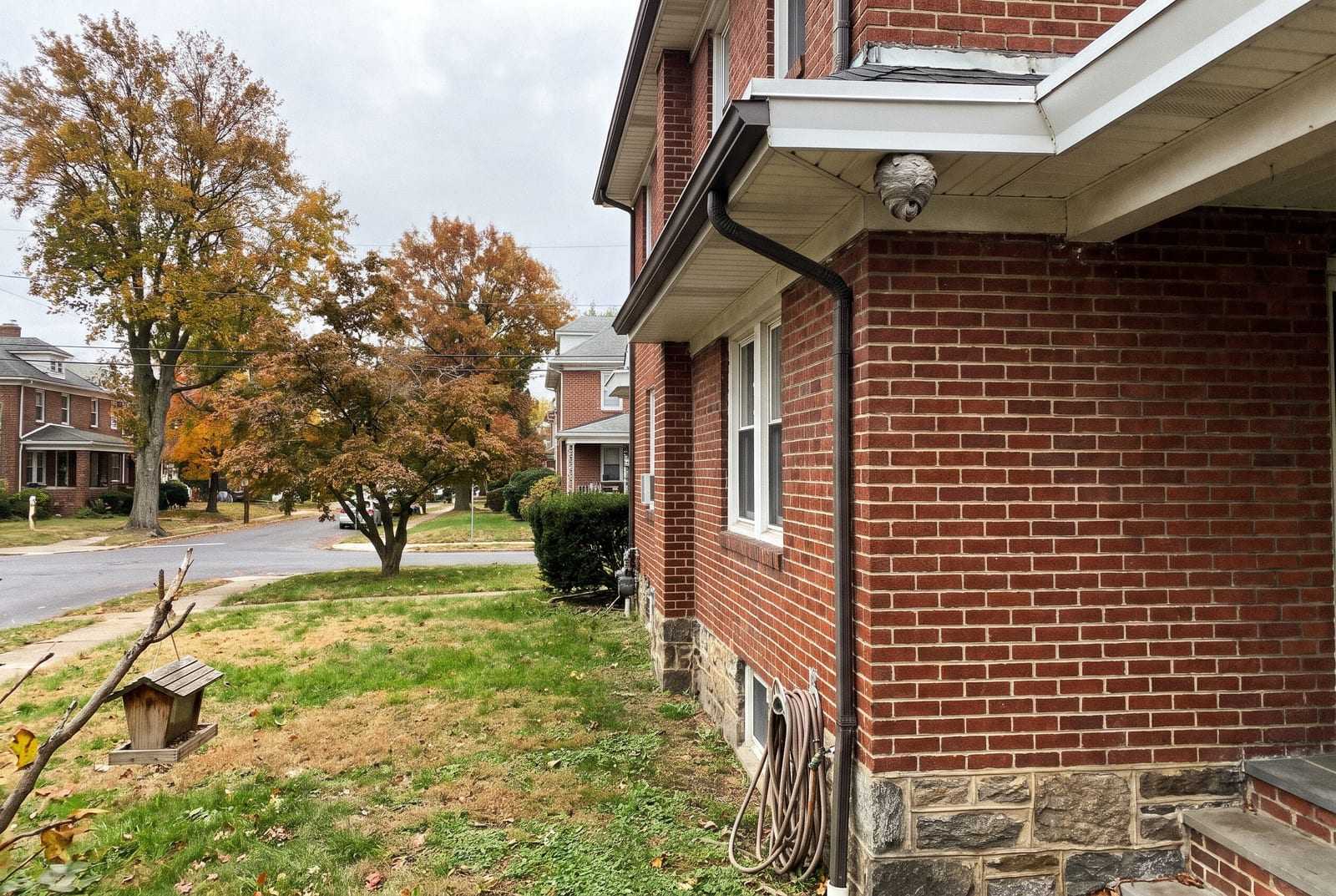
| Bald-faced hornet | Large gray, teardrop-shaped paper nest with its entrance near the bottom | Tree branches, shrubs, the eaves of houses and sheds |
| European hornet | Brown, brittle paper nest inside a hollow; large brown and yellow hornets, active at night too | Hollow trees, attics, barns, sheds, wall voids |
| Mud dauber | Dried mud tubes side by side like organ pipes, or lumps of mud; no paper | Under eaves and porch ceilings, in garages, sheds and attics |
| Cicada killer | No nest above ground: a burrow with a horseshoe of loose soil at the entrance | Bare or sandy soil in sun: lawns, flower beds, the edges of walks and patios |
A Colony Starts With One Queen in Spring

Paper wasp, yellowjacket and hornet colonies last a single season. A queen that spent the winter in a sheltered crack starts a small nest alone in spring, and her first workers take over the building by early summer. A paper wasp nest tucked under a rail or a ledge may stay the size of a hand, with a few dozen wasps. A yellowjacket nest in a wall or the ground keeps growing, and by late summer it can hold thousands.
Late summer is when most stings happen. The colonies are at full size, the workers turn to sweet food, and they crowd trash cans, open drinks and fallen fruit. The first hard frost kills the workers, and only the new queens survive the winter, tucked under bark, in attics or in wall voids.
Will wasps use the same nest again next year?
No. Paper wasp, yellowjacket and hornet nests are left empty in the fall, and new queens build new ones in spring. They like the same kind of sheltered spot, though, so a porch ceiling that had a nest one year often gets another.
Is it safe to leave a nest alone until fall?
Sometimes. A hornet nest high in a tree, well away from doors, paths and play areas, can often be left to die off with the cold. A nest by a door, under a deck you use or inside a wall keeps growing until then, and so does the number of wasps defending it.
What to Do and Avoid When You Find a Nest
- Keep children and pets away from the nest and out of the wasps’ flight path.
- From a distance, note where the wasps go in and out: a wall, the ground, a branch or the eaves.
- Walk away calmly; swatting near the nest brings more wasps out.
- Do not spray the nest with a hose, set fire to it or knock it down.
- Do not plug, caulk or tape over a hole where wasps go into a wall; trapped wasps can chew through into the rooms.
- Do not mow over, step on or pour anything into a ground nest.
- Keep trash cans closed and drinks covered outdoors in late summer.
- Anyone with a known sting allergy should stay well away and keep prescribed epinephrine close.
Do mud daubers and cicada killers sting?
Rarely. Both are solitary wasps with no colony to defend. Mud daubers sting only when handled, and the male cicada killers that dart at people over a lawn have no sting at all.
What should I do after a wasp sting?
Move away from the nest first, since more wasps may follow. Wash the sting with soap and water and hold something cold on it to ease the swelling. Trouble breathing, swelling of the lips, face or throat, spreading hives or feeling faint are signs of a severe reaction: call 911.
Nests in Walls, the Ground and Trees Need Different Work
Wasps are part of our general insect treatment, with targeted applications indoors and along foundations and entry points, and the place a nest sits decides how it is handled.
Across the trade, an open paper wasp nest is treated directly and taken down once the wasps are dead. A nest inside a wall or under the ground is treated through its entrance, usually with an insecticide dust the returning workers carry inside. The hole stays open for several days so every wasp passes through it; blocking it early traps live wasps in the wall, where they look for another way out, sometimes through a light fixture or the ceiling.
In Northeast Philadelphia, paper wasps like the underside of the metal awnings over rowhouse porches and windows, and yellowjackets find their way into walls through gaps in the mortar and around the hole where a cable comes in. Nests are usually treated late in the day, when the workers are home and slow to fly. Empty mud dauber nests can be scraped off, and cicada killer burrows go quiet as summer ends.
A nest by the door or wasps slipping into a wall: call before the colony grows.